From Vouchers to Independence: Changing Our Attitude as Men ===
[00:00:00]
And that's in there for money every fortnight. We
are taught as men that when you grow up, when you get old enough, when you leave school, you either go into a trade or do an apprenticeship or you go and find work and look after yourself. That's how it's supposed to work, eh? You know? You know? Years ago, that's how it worked. You know? Once you get 17 or 18, If you leave school, first thing you do is look for a job.
When
I left school, I left school when I was in Grade 10. My father said, oh well, you don't want to go to school, you're on your own, you look after yourself. And then I had to look after myself. [00:01:00] Doesn't matter, I lived in the park. I still had to look after myself, my dad wasn't going to look after me. And he told me that.
But
today you've got some young fellas who are still holding on to mummy's skirt and still, um, depending on their mother to provide them with money and everything else. And their father. You know? That's how it's not, it's not supposed to be like that. But that's just how things turned out. That's just how things turned out here on Palm.
Because more and more people are more dependent on the government now. Than before. That's why I'd like to see aid. You know? Yep. And you know what? It's a simple thing. Like, company looking for a voucher every fortnight. Dependent on the day, see? Yeah. [00:02:00] People depend on that voucher. They don't have to budget their money.
You know? This is how I see it. Some people don't have to budget their money because they know they can get a voucher to get food. And it's for free, eh? For free. That's being, you're, you're, uh, that's not being independent. You're, that's being independent. The programme, some of the programmes here are making you dependent on them.
And, and by giving out a voucher and keeping you in that dependency mode. And it does more damage than good. Yeah,
because you don't have to work for it. You don't have to do anything. You just get a voucher. Uh, I get some, we think it's, uh, we think we're, maybe it's a situation where we think, ah, it's, it's okay. I get something for free. [00:03:00] It's normal, it's normal here. But it's doing more damage to you. Because it's keeping you dependent on them.
To keep you dependent on Janet and the workers here, myself and Isabel. You're depending on them to give you a voucher so you can buy food. Instead of budgeting what money you get, so you can have food. That would happen Monday, eh? Monday just went past, eh? Yeah. A few people come there, don't they? Faster. I know these ways.
Ah, I'm going to get a badger. I don't know how to answer. I'm going to try to tell them, you know. One after the other. They must be familiar with all the years. There was a company, the last sportman. Yeah, people do that. They go around different places. And if they, it's like a craving. If they don't have it, eh, that badger, it's like, you know, they're going to...
[00:04:00] It's like a badger. Lose or whatever, you know, it's gonna change. Yeah, it's gonna change. Oh, it's like you don't want to give it or go to another round, you know. They'll start cracking up, you know. They'll start cracking up because their thinking changes. Because their thinking changes in a way where
they get angry because It's your job to give me a voucher. And they'll use that, eh? They'll use that. And they, and they, and maybe some people, some will come up and say that. It's your job to give me a voucher. You know, it's not my job to give you a voucher. You know? But some people, the thinking changes in a way where, where some people think that you're, you're personally, Responsible for them.
Okay? [00:05:00] That's how much damage, that system, that's how much damage it has done to us when we become dependent on other people. Because they think you're personally responsible. I had one fella come home to my house at night. Oh, this is a nightmare to die. You're gonna... He come, can you take, take me up the mission?
I'm not, I'm not going anywhere. He turned around and said to me, but that's your job to look after me. You know, and this is that time. So I get paid to help people, yeah, during working hours, that's my job. But after working hours, now that's my own time. But he actually come out and said that, it's your job to look after me.
You know, I just said, give me the f**k over, I'll bust you up.
Yeah, the government created that back in the days, eh. [00:06:00] They made them old people, eh, you know, before they relocated. What do you think? Yeah. Make them dependent on the ration, eh. Ration, yeah. Breaking down the cultural values of life. Blackfellas didn't worry about that, eh, but they sort of gave them an option, eh.
If you don't want a thing. That's exactly what happened. Go away. It was slave labour, you know? Yeah. And you're working for nothing, you know? It's like, you gotta... You're working for that sugar flour. Yeah, yeah, see? That was a cat, the government done it on purpose. And it's still today, we see it today. It's still today there, where people are getting vouchers today.
But that is one way, that's a... Maybe... These things take time, eh, for that to happen. Before we realise. And that's why I say, you educate yourself on these things, you know? And it's like an addiction, eh? Yeah. They gotta have it. They gotta have it. That bad, you see? Yeah. And if they don't get it, they blame you, you know?
It creates something in them, but then they change [00:07:00] straight away and then they start pointing their fingers, you know? They start pointing their fingers? Yeah, see? Swearing everything. They run your hand, you know? Yeah. People do that here now when we got no voucher. That's ours, that's ours. They got no difference.
But being dependent can be, can do a lot of damage to us. In our, in our, changes our attitude, changes our behaviour. In a way where, where we got no control over that. Not only through the courts. But being that, being dependent on, on government things. But I, a lot of people coming in here looking for a phone.
I broke my phone. Well, you broke it, that's your problem. You know, instead of just go buy another one, you know. But there's a free phone up here, so I'll go up and get a free one. It, you know, it don't work like [00:08:00] that. Nothing of the story I had down there no more. Yeah, nothing everywhere. It's only for people on TV.
It's only for people who've gone through a crisis. If they, if the person have to leave the house and go and live somewhere else. You need that phone. To support that person. Same with the voucher. Same thing. But people think they can just get a free phone and get a free voucher, like that, you know. And it got to a point where it got that way, Eanyan, and people came in, Oh, I want my voucher.
Well, they're not entitled to get a voucher. You know, that's just how it is. But that's how much damage that we can do to ourselves, all that system can do to us, where we become dependent on that. That is why we have so many people coming in looking for a voucher every day. Free phone. [00:09:00] Our, our, our main job is to help people in a crisis.
If they need to leave Palm and, and, and, and, man or woman, if they get in a DV situation,
where they have to leave Palm, we got money there, we can put someone up in a motel for a couple of weeks. If they need to get away, you know. Or if they've got to go quarter to town, we'll take them. And they got nowhere to stay. We can put them up in a motel. Things like that. That's what that money in that for, for when people are in a crisis.
And that applies to you men here too. If you're going through a hard time at home, and you need a, need a break, we can put you up in a motel for a week or so. So you can... Maybe go and try and get counseling, or something, you [00:10:00] know.
But we got, what money, what things we were provided for people in a crisis. That's our job.
Same with the vouchers, suppose to be for people in a crisis. Same with anything else, same with the phone. But some people like to take advantage and... I just want a free phone. You know. I had one fella come in, he had a phone in his hand. And he still asked me for a phone. I said, you got a phone? He said, yeah, but you give out free phones?
I said, nah, nah, nah, it don't work like that.
I remember when we used to all get a free phone from Jopart before I was here. Yeah. I remember when we used to all go and do that. Yeah, they used to do that before. When we were back in CB. Yeah. We used to all go there for our appointment, and they used to [00:11:00] give us a free phone. Yeah. Yeah. Yeah. Three days later, the witnesses tried the same phone for the CI.
Oh, ah. That's what they did. I think that's what, that's what people do. But I think, I think community correction still does it. Just for you to stay connected. Like, especially if you're in the mainland. If you can't make it, like just say you're working, you get a phone, you phone through, see, you know. It's part of a little thing, and it's supposed to supply you with a bike, like your own transport, especially if you, to get to one place or the other.
Thank you. Thank you. Just to get in there if you can't sign on it at a certain time. Yeah. I was like that when I was in Sydney working. I just found through. Yeah, yeah. So, later each of the fellas said, Are you right? I was like, No, you found him, you know? Yeah, yeah. A little Asian fella. He was a pretty good fella too, you know?
Yeah. From that situation where we went through. Yeah, yeah. But that's part of the thing too. Uh, give you that extra support, see? Oh, ask him about it. Yeah, that was good. That still should be in the thing. It should be. What's the name, you know? Yeah. Just to say, in touch, like, if you [00:12:00] can't make it, you, you found a troop.
And it's, it's already recorded, see? I've, I've given that phone to a couple of people who was in that situation. Mm. Where they couldn't contact. Yeah, yeah, yeah. You know what I'm saying? I've, I've, I've given that phone to many. To do that. You know? Um, well that's a situation like that where we do give out phone numbers.
Yeah, yeah, that's it. Yeah. In, in, when, where if there's a situation. Yeah. If there's a crisis, you know? So you don't end up in jail, you know? But that's our role, is to deal with, with that sort of thing. But um, it's not, it's not, it's not about just getting a free phone or getting, it's about attitude.
Because people's attitude change. And, and we need to, we need to change our attitude and, and make our, and work towards being independent of government. You're not going to be fully independent. I say we [00:13:00] all, you know, we need government. We need government in our lives sometimes, you know. Hehehe, you know.
They provide good things too, the government, I don't know about that. But they provide situations where you get the victim assist payment, you know. And some of those things, they can provide, they can help you, you know. But we've just got to be aware of, we've just got to be aware of our own self. Whether we, we are becoming dependent or whether, uh, we want to work toward dependency, uh, independency.
Um, that's a separate issue than, that's a separate issue than, than what the, what the government does, you know. But they do provide some good programs. But we just got to be aware of that if we, we don't become dependent on, uh, in, in that situation. Um, but like I said, As [00:14:00] men, we are, we are growing up, we are taught that men go out and work and look after their family.
We are taught that men protect their family. And it happens here, all the time. But we are taught that when we are growing up, when we're boys.
So the, and the, the normal thing or the, what's supposed, what's supposed to happen is we get up when we leave school and go and look for a job. We don't look after our family, but a lot of times that doesn't happen. Um, Palm is a situation where there's not really, not really, not much work, eh. It's hard to get a job, but that doesn't stop us from getting a job, getting training, and going out on the mainland and working.
Nothing's stopping us from doing that. You know, I was told about a young fella, um, he's still working out in the mines there, Maverick, eh. Maverick. I skied about him because he's going out there, [00:15:00] done his training in the mines, and he's still out there working today. He's married up. He lives in Cloncurry.
That's deadly. You know? And he's still out there working today. You know? A lot of other, a lot of other brownfellas went out there and done the same training at the same time as him. A lot of them left to come back here. But I skied about him because he's stuck to it. He's working, he's married up. Got his own place in Concurry.
Still working in the mines. And that's deadly. I think that was, I think that was deadly. And, and nothing's stopping any of you fellas from doing that, you know? Or going to places like Batchelor up in Darwin. Batchelor, that's a, it's a university now. Yeah. Yeah, it's not a college anymore. It's a university.
It's a university. But you can go there, they got a lot of stuff [00:16:00] there that you can study. They got construction also in the, in the, in that. Isn't it? Isn't it? I'm sure I know which one you're talking about. Charles Darwin? Charles Darwin University? Yeah, they, they, uh, connected to Charles Darwin. Yeah. You go to Charles Darwin.
I can't remember which one you're talking about, but I went there. I went there when I was doing several months training with Kawanyama. They sent me to that place now you're talking about. Yeah. They're connected onto the main university. Yeah, they're connected to Charles Island. And, um, people from all over go there, from all over Australia, to go to bachelor.
And the old people too, you know. And they get their degree, and they get their, whatever they trained, whatever they got. They got all that up there, they got, uh, how to run a radio station. They got, uh, media, media training. They've got construction, uh, they've got a lot of, a lot of different training up there [00:17:00] that you can do.
Uh, ranger training too, they can do rangers. When I was there, they were doing rangers. But nothing's stopping you from doing that. And they've got indigenous section in all universities right throughout the country. You can go to Perth, go to uni over there, they've got an Aboriginal section there. Sydney, Darwin, uh, Sydney, Melbourne.
They got it all over. Nothing's stopping you from, from signing up and doing that. To educate yourself, to make your, so that maybe down the track you can get a better job. Maybe you can get, with a better pay. You know, the whole purpose of that is so that you can. Um, because we, we, on Palm we're living in two worlds.
We living in our, our, our world. With our culture, we're living, we still practice a bit of that today. [00:18:00] So we gotta, and plus we're also living in a white man's world. So we gotta balance it out. We gotta balance it out. Coming to work, when I'm home, yeah, I'm myself. I'm a Bulgaman now, you know. I'm a black man, but when I come to work, even my, how I talk gonna change, because I'm coming into a white man's world.
And I'm gonna change to suit that, where I, my work environment, so we don't make, we do that all the time. When we go to Townsville, we act differently, we behave differently when we go to Townsville. Because that's their world isn't it? No matter where we go. So we're constantly changing from one side to the other.
And we're going to find a way to deal with that. We're going to find a way to be [00:19:00] able to do that. To live in, to, to bring those two cultures together. And to be able to function within both sides, in, in both of them, you know? And it takes a lot of, it takes a lot of doing, to tell you the truth. And, and a lot of people do make that.
Be able to do that, you know? You know, to be able to do that.
But we, we can do it, but we just need to work at it. But we have to start off by changing our attitude. You know, I
read a book about, uh, to educate myself. Tell you the truth, when I used to drink I hated white people. I hate [00:20:00] not white people. Not only how they treated me, but how they treated my parents. But you know what, when I got so old I had to change. So I had to educate myself. So I read books, history books, things like that.
Um, educate myself on that. The real history of Australia. Because my thinking was all white people were bad. You know, that's how I thought. That's how I thought. But after reading the histories, the history books, a book by Noel Lewis, he used to, he used to be at the James Cook University, he wrote a couple of books.
Um, my thinking changed, my attitude changed. Because even back then in the old days, there were white people who tried to save black people, and who have saved black people, [00:21:00] you know, from being killed. Taken and put on palm, you know, things like that. There were some good people out there. And that's where my thinking changed towards white Australia.
Because I thought white Australia was all bad. But my thinking changed and my attitude changed. How I interacted changed with white people. How I, um, um, and things have changed in a way where, yeah. Good things happen and bad things happen, you know? But, a lot of people write about the bad things that happen, but there's a lot of good things that happen too.
And, uh, like I said, I read about it, I read the diaries, what they wrote, and, and there was some good too, you know? It wasn't all bad, you know? Like, maybe some people make out it to be. But, um, the main thing was to change my attitude. Thank you. [00:22:00] The main thing was, I'm living in this world today. It's a different world from when I was growing up.
It's about education today. And it's about living in two society and bringing it together. It's about making me feel good about me. And changing. So that's a process maybe we need to go through. To make that change. You know, because if we don't, we're going to be left back there. You know, and one of the first things I, one of the, one of the things I had to do, I had to go and, like I said, bachelor, I went to bachelor.
I'd done four years there, got my degree. I was 52 I think when I went up, 52 or 53 when I signed up to go to bachelor. Some people might think that's too old, you know. [00:23:00] But bachelor been around for generations. It's been around for twenty, thirty years or something. You know bachelor, I think. I know it's been around a long time.
But to change my life around to what it was, and to educate myself, I had to go to bachelor. To educate myself, I had to go walk on my mother's land, up Wipa, up Mapungi. I had to go walk that land, walk on their country. And meet family and talk and, and interact with family up there. I had to do that to make changes, to make, to change myself.
And this is where that money, you know, for that men's group. I think the men's group got, uh, 1 point something million. 1 .9, eh? 1 .9 million. And that's for this sort of thing now. So they're gonna be meetings about it, eh? Hey, it's all [00:24:00] good. And that's what, um, they're working towards now, making changes, men make those changes.
But, to make the changes, we have to make that, we have to make that effort on our own, to go and, and do those things, to make that change. Educate ourselves. You know? And that's why there's that purpose for it, eh? And the purpose is for it to change, to change. To make that change, and we have to, it's up to us as individuals to make that change.
Don't wait for the, no one's gonna do it for you, you have to do it yourself. No one's gonna make, do it for you.
If you find yourself, maybe you might wonder too, how come I keep getting into trouble? How come I'm still going to jail? How come I'm getting tired with this over and over? Maybe it's time to look at yourself and say, What am I doing, [00:25:00] um, to make that change? You know? What am I doing to help myself? Because no one's gonna do it, they're not gonna do it for us.
And um, we have to make that change for ourselves. But you know, in the end, our, we benefit, and our families benefit, you know? But we have to make that change, because tell you what, tell you the truth, that cemetery is full of people who never made that change. Didn't bother. That cemetery is full of people, our family down there, even our family, people who never made that change.
That cemetery is full of them, young people too, died young. I
think I can only take one [00:26:00] person. I think
there's only one person alive that I was in the same class with. Out of a group of like 12 boys in one class. I can only think of one that's still alive today. Yeah, all the rest all passed away. Mmm, that's sad. But, the world has changed, and people, we have to change with it. And to be able to find a good job, I think it's important.
And make a decent living is to educate yourself. Change your attitude. Change your behaviour. These things have to, have to happen if we want to live in this world today. Because things have changed. When [00:27:00] you look at what happened in Kauranga, My brother, B. Lawrence, he run the men's group. And after, my wife Nikki, Mum passed away.
We haven't had a job for more than seven years. And when he was in the men's group with Brother Dogai, we were lucky enough to score funds from, um, Beyond Blue to get a men's donga. And now we've got that same donga situated up near the airport. But what happened with Albert is, we all knew that we were going to have black deaths in custody in Kaunyama.
Yeah. I'm worried about that game. Brand new dongas, two cattle company when it was for men's crew. And they gave us a whole band that donga. Yeah. And when they gave us that donga, band that donga, before they gave us that, that's when my cousin brother from Northland got, he got flogged up in the White House.
[00:28:00] Yeah. And I was in custody at the time, I went on Facebook, and I was guessing the right time that brother donga went to the police station, took him back to the hospital, and pronounced when he was dead. When I was in Cairns, I woke up drunk. Yeah. And he said, I came in there and I said, look, I've robbed them that place.
I know a lot about it. I said, I got very wild because the cow came in, took the new donkers over and gave us an old rotten donker and everything got stolen out of it. Yeah. And we got that old donker before that. Black deads in custody. Because we had two black deads in custody. One were Arapuna, one were Kauinyama.
Ah, yeah. I was in Cairns at the time and I had family in Papua. Harukū town moved from Kaunyama, stretched away. We still got that policeman back in Kaunyama, he never been jive. The other police officer, we got him kicked out of Harukū, and he's in cage. Yeah, they were just bracing me back. Really? [00:29:00] On the way or what?
You try to contact what, um, uh, rather do all your work for Queensland now, but... Yeah. I have municipal buildings in the PC. I see, Kaunyama. At we got a little building this time, down the corner, not far from the coffee shop. But we not use that building, we more or less put more artifacts in there, and we more or less count on PCYC.
That's where we have a winds group. Well that's what he's saying with that funding, this might boost that thing along. It was Brother Stanley who continued it, and Yarraba got the other 1 .1 to set something up in it. Just like in the pipeline. Yeah. I don't know, we'll just tap into it. When we took it off your mouth, I thought, maybe if we can, like, dip into it.
I said, can we get a couple of vehicles for us men, you know? Yeah. You know? Yeah, I'll do that. Bamboo Creek or Bay, whichever way. Yeah. Get out of the mission, [00:30:00] you know. That's men, you know. They say now it should be affordable, you know. Like a trophy and a jewel cap or two trophies, you know. That's part of the men's thing anyway, you know.
But at the moment, like you're saying about the dollars, I had two or three dollars just around the airport. That's what they're using. At least they didn't let you say that. They're using, see? That was for the men's group, Danny. That was for the men's shelter, just as a start, you know. See? See, look, I'm used to getting in touch, but, um, my brother Bill Lawrence there, he used to run the men's group, but after he lost his wife, Marty, he's been out of job for, like, more than two years, and he looked pretty wrecked, like, you know, not like a freak wreck, but...
Yeah, I don't even let him go to court. He's my good mate, that's all. He's my good brother. Yeah, he didn't go away at all.
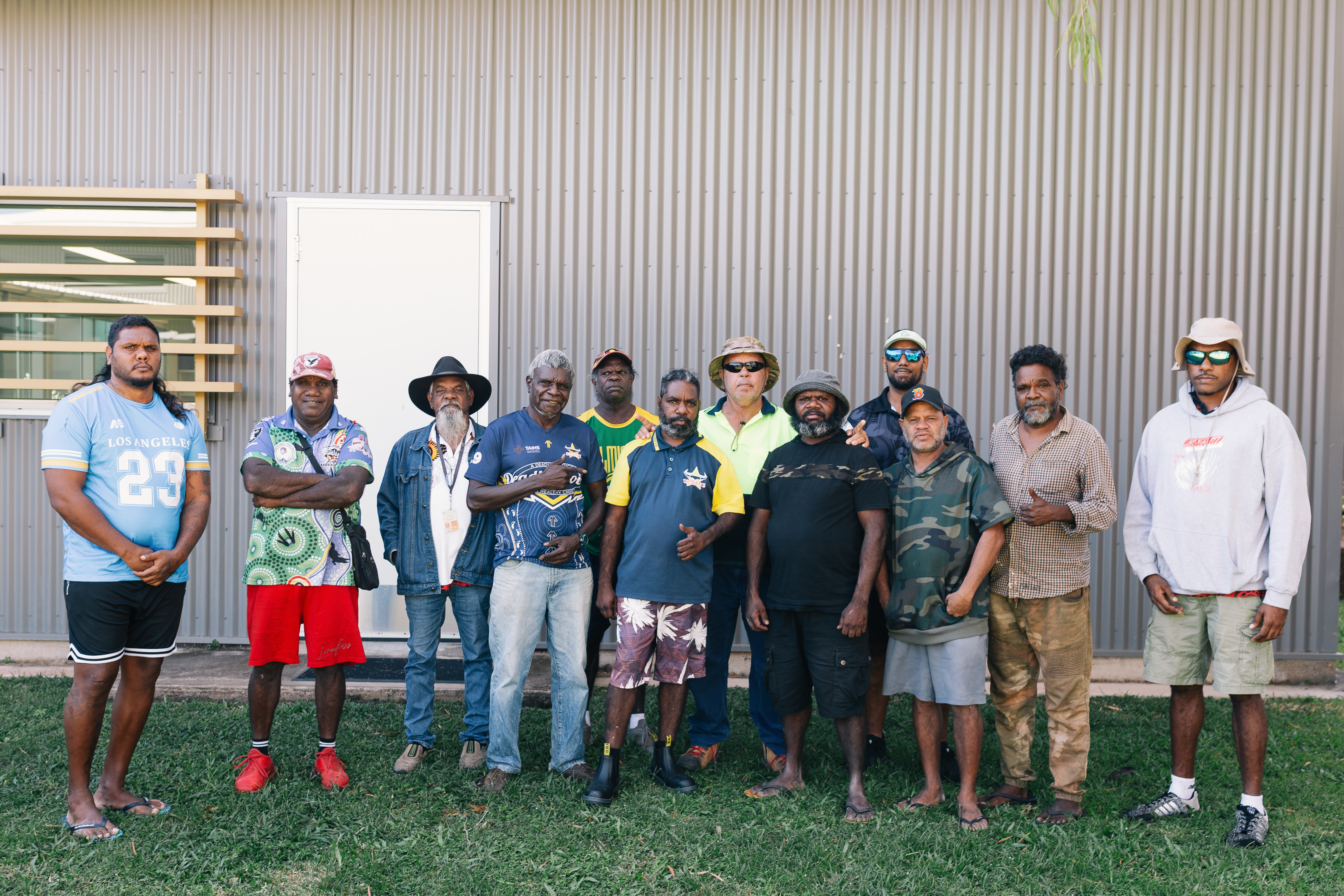
Men's Group
Palm Island, Queensland, Australia
Men's Group is a transformative collective born from the shared experiences of overcoming addiction and seeking genuine purpose beyond substances. Originating from personal struggles with alcohol, they inspire others to define their own daily motivations and break free from dependency. Unlike the mindless routines dictated by addiction, they emphasize intentional living and self-determined goals. Through candid dialogue, Men's Group empowers individuals to reevaluate their priorities, fostering a profound sense of satisfaction and accomplishment. Their unique contribution lies in guiding others to craft authentic purposes and enrich their everyday lives with intentionality and resilience.
Stories like this matter
Help amplify voices from communities that deserve to be heard. Share this story or stay connected for more.